RAGBench¶


RAGBench tells you which retrieval-augmented generation setup to deploy for your documents and your questions. It runs many architectures (lexical, vector, hybrid, reranked, LLM-driven, tool-using agents, decision-gated abstention and more) on the same data, scores retrieval, answers, cost and latency with confidence intervals, and ends with a recommendation and a runnable winner.yaml.
It is not a demo chatbot, and it needs no API key to try: without one it runs on deterministic mock models so you can see the whole pipeline first.

A real ragbench auto --mock run on the bundled demo documents (no key, a few seconds), then the report of the published benchmark. Remake it with python scripts/make_demo_gif.py.
Three things it does¶
- Trust the numbers. Every score comes with a confidence interval, repeated trials show run-to-run noise, an independent judge (never the generator's own model family) can be a panel, answers can be compared pairwise, faithfulness is checked claim by claim, and a held-out test split keeps tuning honest. Statistically tied systems are called ties. See the methodology.
- Benchmark anything. Built-in architectures run next to what you already have: an HTTP endpoint, a Python function, LangChain, LlamaIndex and Haystack pipelines, agent harnesses (Claude Code, Codex, OpenCode, any command), and any model through OpenRouter. See benchmarking external systems and models.
- Improve the winner.
ragbench optimizerewrites a system's prompts and knobs on the train split (Propose → Probe → Compose, after Google's Harness²) and keeps a change only when a held-out test split confirms it. See optimization.
How it differs from RAGAS, ARES, TruLens, DeepEval and promptfoo, and when to use them instead: comparison.
Benchmark your own RAG, agent or model in 3 commands¶
ragbench init my_bench --docs ./my_docs                  # writes my_bench/ragbench.yaml and a questions.jsonl to edit
# add your system to my_bench/ragbench.yaml next to the built-in ones (see below), and edit the questions
ragbench run --config my_bench/ragbench.yaml --mock      # 1. check the wiring offline: no key, no cost
ragbench estimate --config my_bench/ragbench.yaml        # 2. what a live run would cost
ragbench run --config my_bench/ragbench.yaml             # 3. the real run: it shows the estimate and asks before spending
What you add is a few lines of YAML, whichever of these you are measuring:
systems:
  - {type: external_http, name: my_rag, retrieval: {url: "https://rag.internal.example/ask"}}                    # a RAG you already run
  - {type: python_callable, name: my_fn, retrieval: {target: "my_pkg.rag:answer"}}                              # a Python function of yours
  - {type: cli_agent, name: claude_code, retrieval: {preset: claude_code, model: "anthropic:claude-haiku-5-5"}} # an agent harness
  - {type: hybrid_rerank, name: glm, models: {generator: "openrouter:z-ai/glm-5.3"}}                            # a pipeline on another model
The details of each, and how your system's documents and ids must line up with the labels, are in benchmarking external systems.
Not to be confused with Galileo's RAGBench (arXiv 2407.11005, rungalileo/ragbench), a labelled dataset for RAG evaluation. This project is a tool that benchmarks RAG systems on your own data; it can read datasets like that one, and it shares only the name.
Quickstart¶
pip install ragbench                      # or try it with no install: uvx ragbench demo
ragbench auto --docs ./my_docs --mock     # drop --mock for a real run: it estimates the cost and asks before spending
From a clone, pip install -e . installs the same thing; without Python, docker run --rm ragbench demo uses the image built from the Dockerfile (docker build -t ragbench .; mount your working directory with -v "$PWD":/work and pass keys with -e OPENAI_API_KEY).
auto profiles your documents, writes questions from them if you have none (flagged needs_review; bring your own with --questions), runs a preset of systems, and prints the recommended one with the paths of winner.yaml, report.html and recommendation.md. If it stops, ragbench auto --resume RUN_DIR continues without paying again. Prefer to write the config yourself? ragbench init my_ds --docs ./my_docs scaffolds one; ragbench demo and ragbench run --config configs/all.yaml --mock run the bundled demo. ragbench demo --suite hard and configs/hard.yaml are a harder bundled suite built to separate systems.
Not sure which architecture to try first, or what to look at in the report? Start with Choosing an architecture.
What you get¶
Each run writes one directory: a recommendation (which system to deploy under your constraints, the systems statistically tied with it, a runnable winner.yaml), a self-contained report.html (leaderboard with confidence whiskers, quality-against-cost chart, category heatmap, cost and latency by stage, failure types, and a drill-down into every question with the retrieved passages and the agent's steps), leaderboard.md, and the CSV and JSONL files all of it is built from. ragbench report RUN rebuilds any report from those files, ragbench runs lists past runs and ragbench compare-runs A B flags regressions.
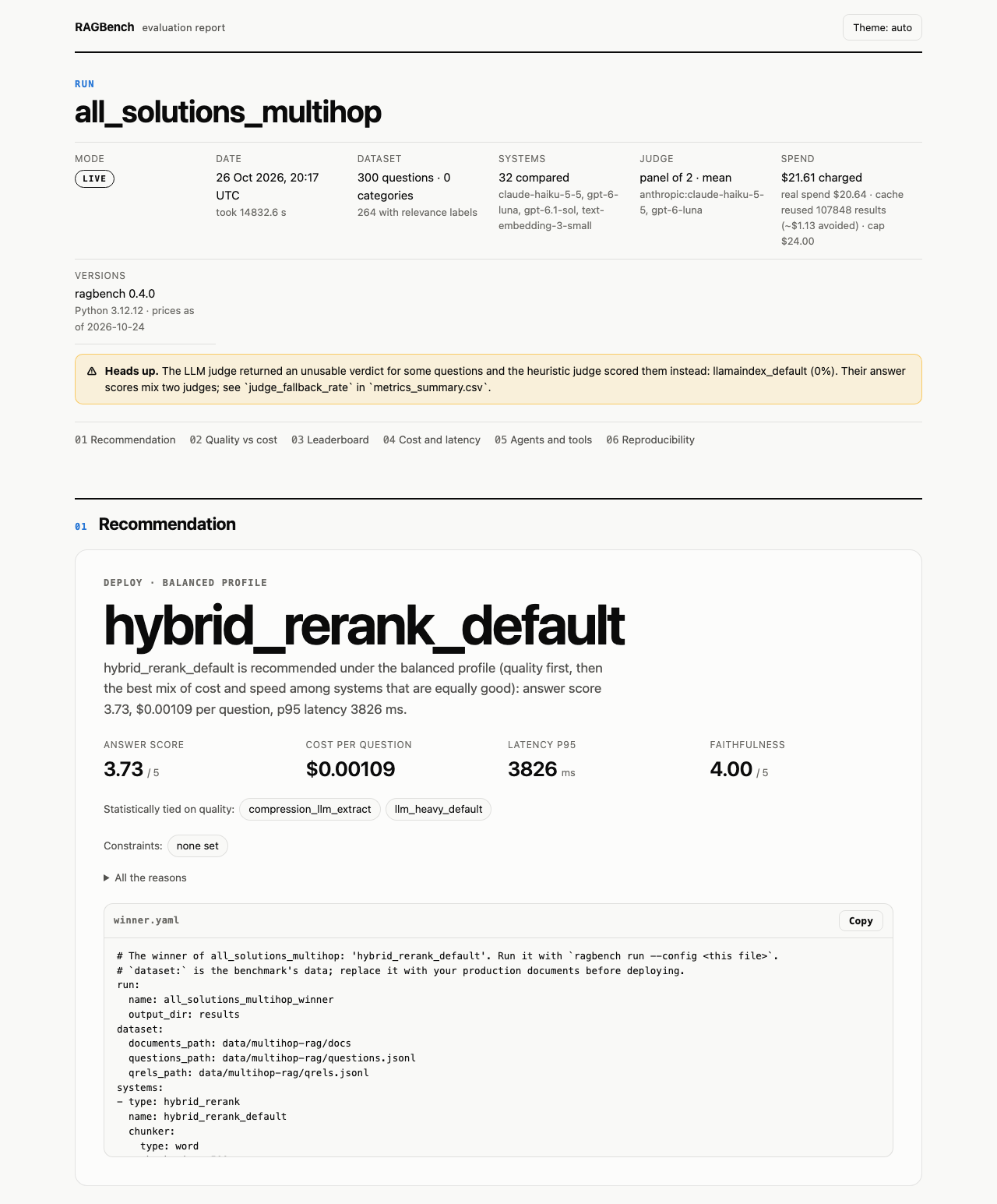
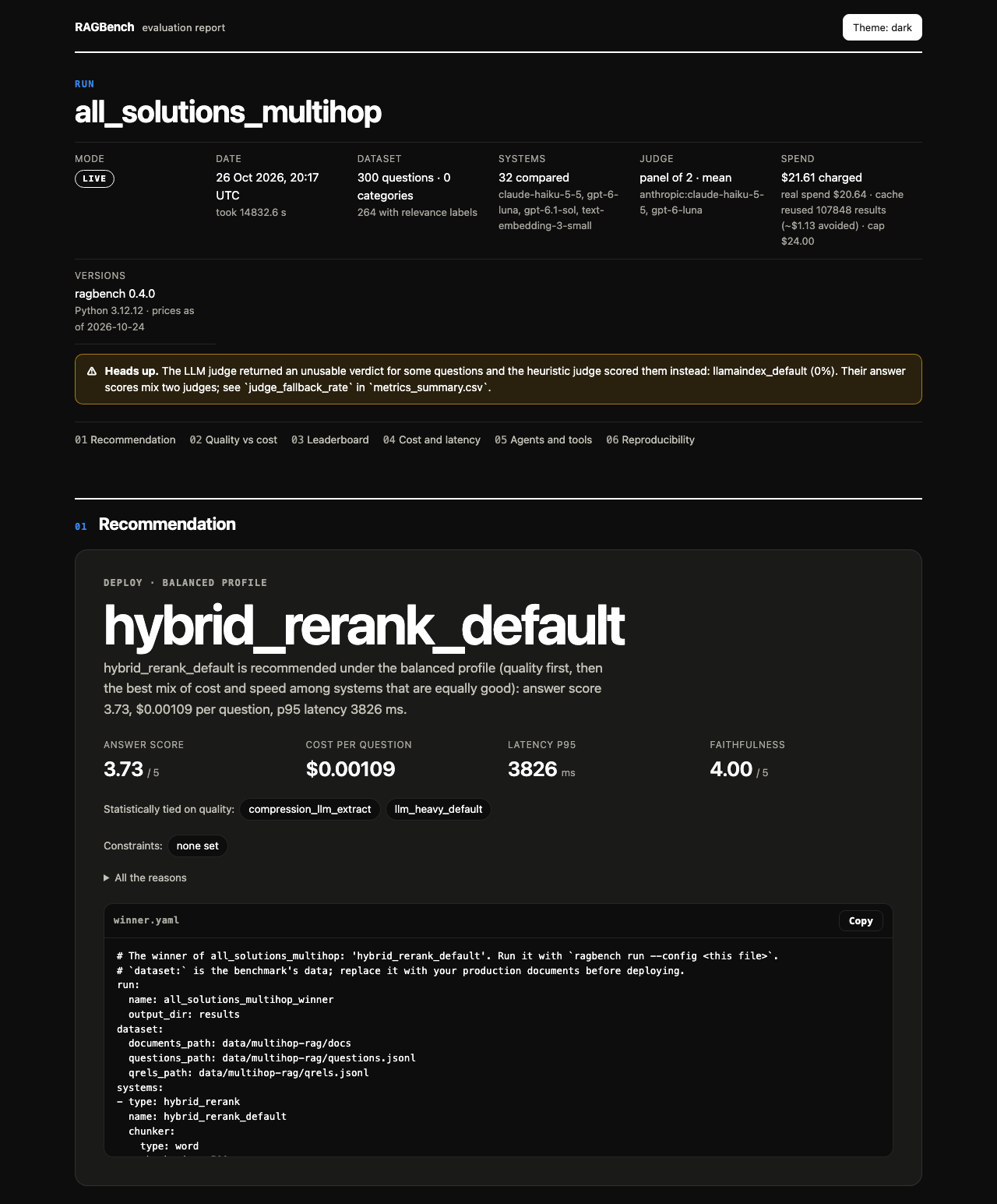
report.html follows the OS theme, has a light/dark toggle, and works on a phone-sized screen.
Where the results are¶
| Looking for | Go to |
|---|---|
| The current benchmark: every system on one public dataset (October 2026) | MultiHop-RAG; its top is the table below |
| Every published run's table, filterable | the docs site's Leaderboard |
| Which page or folder holds what, and how to read a leaderboard | Where the results are |
| Your own run | results/<run>/report.html (open it in a browser) and leaderboard.md |
A published result¶
The headline: a plain pipeline is the pick. The best-scoring system, llm_heavy_default, answers 3.83 at $0.00983 a question; hybrid_rerank_default is statistically tied with it at 3.73 and costs 9× less.
Every RAG solution RAGBench can run, on 300 questions of the public MultiHop-RAG dataset (multi-hop questions over a corpus of news articles, null queries included), gpt-6-luna generating and claude-haiku-5-5 judging. The top five, the recommended system, the floor and the 50k-token long-context entry, the three framework pipelines and the three agent harnesses:
| System | Answer score | Recall@5 | $ / question |
|---|---|---|---|
llm_heavy_default |
3.83 [3.73, 3.94] | 0.667 | $0.00983 |
hybrid_rerank_default (recommended) |
3.73 [3.61, 3.83] | 0.668 | $0.00109 |
compression_llm_extract |
3.72 [3.57, 3.85] | 0.640 | $0.00112 |
corrective_default |
3.68 [3.57, 3.79] | 0.637 | $0.00100 |
rerank_default |
3.65 [3.54, 3.76] | 0.660 | $0.00108 |
no_retrieval_floor |
1.90 [1.76, 2.05] | — | $0.00021 |
full_context_50k |
3.41 [3.29, 3.53] | 0.642 | $0.00581 |
langchain_default |
2.85 [2.73, 2.98] | 0.588 | $0.00088 |
llamaindex_default |
2.60 [2.46, 2.73] | 0.591 | $0.00176 |
haystack_default |
2.71 [2.57, 2.84] | 0.579 | $0.00115 |
claude_code† |
3.55 [3.35, 3.76] | 0.632 | $0.01353 |
codex† |
2.92 [2.73, 3.12] | 0.473 | $0.01598 |
opencode_glm† ‡ |
3.64 [3.50, 3.77] | 0.656 | $0.01023 |
Brackets are 95% confidence intervals. † on a stratified 150 of the questions in a run of their own, so compare them with the others on their own table. The full leaderboard has all 35 entries with significance tests, per-category winners, six open-weight generators and the limitations; the demo-dataset example shows what one run produces. ‡ OpenCode's cost is its own estimate at OpenRouter's cheapest catalog price; OpenRouter probably billed 2.74–4.25× that, about $0.028–$0.043 a question (correction).
What the results show beyond the ranking (patterns):
- Temporal questions are the hardest: the retrieving systems average 2.77 on them, and 7 of the 11 questions no system answers well are temporal.
- The null queries separate the systems most. The frameworks' tutorial pipelines answer many of them anyway (0.59 to 2.22, against 4.37 for
hybrid_default), which is most of their gap. - Spending more per question does not buy a better answer: across the 31 retrieving systems, cost per question and answer score have a rank correlation of 0.02.
Systems¶
| System | Description | Typical use |
|---|---|---|
bm25 |
Lexical BM25 over chunks | Cheap baseline and exact-term matching |
hybrid |
BM25 + vector search fused with (optionally weighted) Reciprocal Rank Fusion | Balanced lexical + semantic retrieval |
hybrid_rerank |
Hybrid BM25 + vector RRF retrieval followed by a reranking pass | Recall of hybrid plus rerank precision |
no_retrieval |
The model answers from its own knowledge with no documents at all (the floor baseline) | Showing how much retrieval helps and how often the model makes things up without it |
parent_doc |
Retrieve small child chunks, answer from their larger parent chunks | Better answer context with precise retrieval |
rerank |
Vector retrieval followed by a reranking pass | Higher precision context selection |
sentence_window |
Search single sentences, then hand the generator each matched sentence with the sentences around it | Precise matching with enough surrounding text to answer from |
vector |
Embedding search with cosine similarity over a pluggable vector backend (exact NumPy by default) | Semantic baseline |
external_http |
Your own RAG service: each question is sent to an HTTP endpoint and the JSON reply (answer, passages, usage, cost) is mapped with JSONPath | Benchmarking a RAG you already run (any stack) against the built-in systems |
late_interaction |
Per-token embeddings scored by MaxSim (ColBERT): reranks hybrid or BM25 candidates, or searches every chunk exactly | Questions whose wording must match precisely (names, terms of art) where one pooled vector per chunk blurs the detail |
python_callable |
Your own pipeline, called in-process: a function (question, top_k) returning a dict (answer, passages, usage, cost) or an AnswerResult |
Benchmarking your own code or a framework pipeline against the built-in systems without deploying it |
compression |
Hybrid retrieval of candidate_k candidates, each cut down to the sentences that bear on the question (LLM quotes, an embedding filter or a decision model), then packed to a token budget |
Long or noisy chunks where most of each passage is beside the point; smaller prompts on long contexts |
decompose |
The LLM splits a complex question into sub-questions; each is searched (optionally in sequence, feeding earlier answers forward), then one answer is synthesized from all the evidence | Multi-part, comparison and multi-hop questions |
hyde |
Hypothetical Document Embeddings: the LLM writes a hypothetical answer used as the search probe | Short or vaguely-worded questions |
rag_fusion |
The LLM writes alternative queries; each is searched (hybrid or vector) and the rankings are merged with Reciprocal Rank Fusion | Questions worded differently from the documents |
contextual |
An LLM situates each chunk within its document at ingestion; the context is embedded and BM25-indexed with the chunk, then hybrid RRF retrieval | Corpora where chunks lose their meaning out of context (many similar documents, pronouns, section-relative facts) |
hierarchical |
Choose documents first from LLM-written summaries and titles, then retrieve chunks only inside the chosen documents | "Which document?" questions and corpora too large to search chunk by chunk |
raptor |
Chunks clustered and summarised by an LLM, recursively, into a tree; the question is matched against chunks and summaries of every level | Questions that need the gist of several related passages, and corpora where one fact is spread over many chunks |
adaptive |
Routes each question to the best of several configured pipelines (exact identifiers to BM25, comparisons to decomposition, calculations to a tool agent, the rest to the default) | Mixed workloads where no single architecture is best for every question |
decision_gate |
Hybrid + rerank retrieval, then a typed decision model drops chunks that do not help answer the question and abstains when the rest is not enough | Corpora where many questions have no answer in the documents, and a confident wrong answer costs more than a refusal |
full_context |
Puts whole documents (the whole corpus when it fits) in the prompt, most relevant first by BM25, up to a token budget (the ceiling baseline: do you need retrieval at all?) | Small corpora, and measuring how much a retrieval pipeline loses against reading everything |
graph_rag |
An LLM extracts entities and relations from every chunk at ingestion and writes a report per graph community; local follows the question's entities to their chunks, global answers by map-reduce over the community reports |
Questions that connect entities across documents (local) and corpus-wide questions about themes and groups (global) |
agent_search |
A function-calling agent that searches the corpus and calls its configured tools (calculator, date_calc, corpus_grep, ...), then writes the cited answer | Questions that need computation, exact lookups, or several searches |
cli_agent |
An agent harness (Claude Code, Codex, OpenCode or any command) answers each question by searching a read-only copy of the corpus in a fresh workspace | Measuring a coding-agent harness as a RAG system: how well, how fast and at what cost it finds the answer in your documents |
corrective |
Retrieve, grade each chunk with the LLM, and when too little is relevant rewrite the query and widen the search; optional answer self-check | Corpora where the first search often misses and a bad context should be noticed rather than answered from |
grep_agent |
An index-free agent: it lists, greps and reads the raw documents with tools. No chunking, no embeddings, no vector store | Small or exact-match-heavy corpora, and testing whether you need retrieval infrastructure at all |
iterative |
Search, ask the LLM what is known and what is missing, search for the missing part, and repeat until it says it is done or the hop limit is reached | Multi-hop questions whose second search depends on what the first one found |
llm_heavy |
LLM-driven ingestion metadata, query rewriting, and reranking | Higher-cost, quality-oriented experiments |
Every system implements the same interface and runs on any dataset. Options and trade-offs: docs/systems.md.
Documentation¶
- Choosing an architecture: which systems to try for your corpus, questions, budget and privacy needs, and how to read the result
- Configuration: config sections, presets, sweeps, budgets, caching, concurrency, model providers
- Models and providers: which generator, judge and embedding to use, prices, OpenRouter and open-weight models
- Dataset format: documents, questions, qrels, importers, generating questions and labels
- Benchmarking external systems: your deployed RAG (any HTTP endpoint) or your own Python function next to the built-in systems, in 3 steps
- Methodology: metrics, the judge, statistics, cost accounting, how to read the report, limitations
- Result files and the site: versioned JSON Schemas for
run_summary.jsonandmetrics_summary.csv,ragbench runs sitefor many runs on one page, and the docs site with its generated leaderboard - Exporting traces:
ragbench export-tracessends a run's traces to Phoenix, Langfuse or any OpenTelemetry backend, or writes them as JSONL - Optimization:
ragbench optimizeimproves a system's prompts and knobs on the train split and keeps a change only if the test split confirms it - System wiki: how every system, chunker, reranker and agent works, with diagrams
- Systems and tools (generated tables), command-line reference (generated)
- Extending RAGBench: new systems, tools, chunkers, rerankers, loaders, vector backends and model providers
- How RAGBench compares: RAGAS, ARES, TruLens, DeepEval, promptfoo and Harness², what each is for and when to use it instead
- Where the results are: which benchmark is current, which page and folder holds what, and how to read a leaderboard
- MultiHop-RAG benchmark: the current published benchmark, every system on one public dataset
- Example run: one live run on the demo dataset, end to end with its result files
- Decision gate evaluation:
decision_gate(OpenAI Decisions API) measured againsthybrid_rerank,correctiveand a no-retrieval floor on the demo dataset, and when to try it - Changelog and the release checklist
Live runs spend real money, and LLM-heavy and agentic systems spend the most; see cost accounting and how to cap spending in configuration.
Roadmap¶
Not built yet:
- Persistent vector store adapters for Postgres / pgvector
- Multilingual evaluation: language-aware chunking, and question sets and judges per language
- A web dashboard server for comparing runs (today: the static
results/index.htmlfromragbench runs index)
Contributing and license¶
CONTRIBUTING.md explains the workflow and the checks a change must pass; please read the Code of Conduct too. Released under the MIT license.